Reproduction of the Failed Migrated 3D Models
Project Responsibles:
from CERN TS Departement: Eric Van Uytvinck
from Center: Alexander Sharmazanashvili, Archil Surmava, Vladimer Shekriladze, Besik Kekelia
Year : 2008
The project established and operated a distributed engineering workflow for migrating legacy CERN ATLAS detector CAD models from EUCLID to CATIA while preserving geometric fidelity, engineering usability and migration traceability. It combined automated/semi-automated model conversion with quantitative mass-property verification, CGR/CATPart comparison, 3D visual discrepancy analysis, quality-control reporting and model registration. The work was performed collaboratively between CERN and a CATIA Engineering Center team in Georgia, with different remote-processing architectures evaluated to optimize manpower, reliability, data management and scalability for the migration of thousands of ATLAS engineering models.
A central challenge was that CAD migration could not be treated as a simple file-format conversion. The resulting CATIA models had to be checked to ensure that the geometry remained consistent with the original EUCLID models. The project therefore combined model conversion, geometric verification, visual comparison, reporting, data management and distributed collaboration between CERN and a CATIA Engineering Center team in Georgia. The planning documents explicitly considered different distributions of work between CERN and Georgia and estimated staffing requirements for each approach.
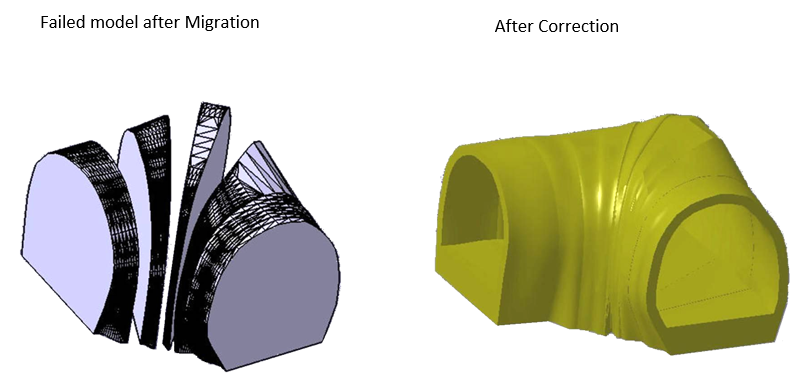
The validation environment, identified in the reports as ATLAS DMU Web, was used to check migrated models and produce structured comparison reports. The process considered the availability and integrity of VRML/CGR and CATPart representations and compared important geometric properties of the original EUCLID and resulting CATIA models, including volume, surface area and centre of gravity.
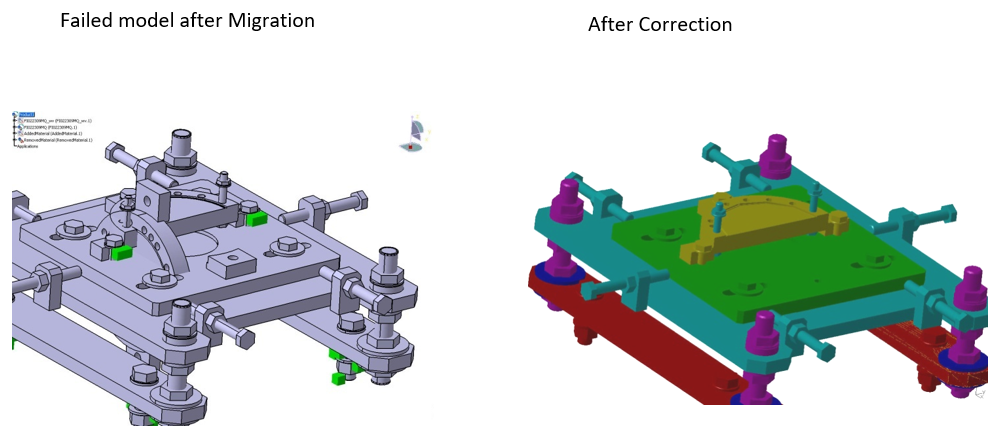
An important part of the project was therefore the detection and diagnosis of conversion errors. The initial comparison example demonstrates why this was necessary: although the CGR representation was reported as fine, the CATPart failed validation, with very large differences between EUCLID and CATIA values—for example, the reported volume changed from 1221.807 to 3985.742 and a major displacement appeared in the centre-of-gravity coordinates.
The project also addressed the operational architecture of large-scale migration. Three possible tool/workflow configurations were evaluated: ESS Tool, CDD Tool and Consult Tool. The ESS approach placed conversion at CERN and remote model recovery in Georgia, requiring two people in Georgia and two at CERN. Its advantages included independence from the sometimes-fragile CDD resource, elimination of CDD registration and comparison-report requirements, and access to the latest conversion software; however, it required more manpower and provided less systematic migration history.
The CDD-based workflow moved both remote conversion and model recovery to Georgia while retaining CDD and SmarTeam registration at CERN. This reduced CERN-side staffing to one person and increased the Georgian team's direct contribution. Importantly, it provided systematic model organization and a detailed migration history for each generated CATIA model. The project documentation states that the team already had successful experience transforming up to 3,000 ATLAS models and was familiar with CERN's remote procedures and resources. Its principal risks were dependence on an older conversion-software version and the stability and future support of the CDD resource.
The Consult-based alternative minimized CERN manpower further—to approximately half of one person's effort and maintained detailed migration reports without requiring CDD registration. Its disadvantages were infrastructure reliability, lengthy remote upload/download procedures, weaker systematization of models and use of an older conversion-software version.
Report: .pdf 667Kb